
RESPECT STARTS SMALL
How brands can help rebuild trust and be culturally relevant

Show some respect
There was a time when people enjoyed a trip down to their local shopping centre. They made a day of it. Some still do. The opportunity to switch off from the working week with a little retail therapy.
However, shop workers have spoken out about the mental health impact caused by abusive customers, in a sector severely affected by rising levels of shoplifting and retail crime. Three quarters have experienced abuse this year, with 43% wanting to quit their jobs as a result. That’s pretty shocking. And it’s part of a wider malaise the UK finds itself in.
Over the past few months, we’ve been working closely with the Retail Trust, Hello Tomorrow & BigTop PR to launch Let’s Respect Retail, a campaign designed to challenge consumer behaviour and combat shop worker abuse. As the campaign reached its crescendo on Black Friday, it’s interesting to interrogate the root cause of this breakdown in respect and common decency. And what, if anything, can businesses and brands do to make people feel happier, optimistic, and more respectful again?
Why are we unhappy?
The UK is officially one of the unhappiest countries in the world. Why?
The 25th anniversary edition of the Edelman Trust Barometer highlights a crisis of grievance and a profound shift to the acceptance of aggressive action, demonstrated by the horrific stats highlighted by Retail Trust’s research and the growing political polarisation – the biggest in my lifetime – deepening fears even further, accentuating a widespread sense of grievance and unhappiness.
The fallout of COVID combined with rapid technological advances, has profoundly changed the way humanity connects, communicates and trusts one another. In the Edelman report, an astonishing 61% of respondents are aggrieved. According to CEO Richard Edelman “they don’t believe the ‘system’ is working – they feel pressed in terms of their bills, they find it difficult to navigate this world of misinformation, and they have no hope for the future.”
So how can hope and happiness be restored?
1. Ticket to the game
Rebuilding trust
When I started my career in advertising and branding, ‘trust’ was almost a given, a ticket to the game. People generally scoffed if it was even suggested as a core value. If you didn’t have it already, then you might as well pack up your things and go home.
Somewhere along the line, many companies and brands got complacent. With the increasing desire for speed, efficiency and short-term results, most focussed so much effort on themselves, they lost sight of the true benefit they bring to customers, and consequently, their trust.
As former RSA CEO Andy Haldane commented recently, “In a world where transparency has become a watchword for good governance, and we seem to know so much more, how is it we appear to trust so much less, including our communities, businesses and civil society organisations?”
Homebound, a study by Princetown sociologist Patrick Sharkey, highlights an astounding change in time spent at home – in the UK, the average time spent inside our homes daily is 18 hours and 43 minutes. Technology is shifting us away from the communal activities we once enjoyed outside our homes, leading us to an increasingly insular, home-based experience.
Leading expert on trust in the modern world, and lecturer at Oxford University, Rachel Botsman points to a profound change in the way we live our lives: “Small, simple moments of cooperation are needed for trust to flourish – our minds and bodies were not designed to be self-contained, on demand, homebound individuals. Get out. Generate some social electricity. We can transform communities and trust in our lives by the simple act of doing things together.”
The importance of social connection is plain to see. Running for over 80 years, the Harvard Study of Adult Development has long concluded that “our connections with one another keep us happier and healthier. Period.” Retail has always been integral to building human connection.
But we’re living in an age of doubt where people don’t trust politicians. They don’t trust the news. They don’t trust each other even! Ad guru, Sir John Hegarty sees an opportunity for brands: “Trust, which once anchored communication, now seems almost old-fashioned. But in this confusion lies something rare. A creative opening. When trust is low, the truth becomes rare. And when something’s rare, it becomes valuable…Focus on the truth. It still works.”

How do we fix the descent into grievance? According to Edelman that is only possible with government, NGOs, business and media working together to give us facts we can rely on and trust. This can improve optimism and overwhelm grievance. Abuse spreads. But respect can too.
This is what sits at the heart of the Retail Trust’s Let’s Respect Retail campaign - bringing optimism back to the UK’s high streets. Simple acts of doing things together, being social and human. Respect starts small – a hello, a thank you, a smile. Small behavioural nudges that together can hopefully make a bigger difference.
2. We’ve lost control?
Empowering agency
What else is causing unhappiness and a break down in respect? People are feeling the squeeze, and there’s no doubt that making Brits richer on a per-capita basis would help. But as a recent study by FocalData highlights, cultivating high-agency people and institutions are equally as important.
For those of you not familiar with the term ‘agency’, it essentially means having the freedom to improve your own circumstances. In other words, to feel in control of your life. Agency, combined with trust are critical in determining the level of optimism in our jobs and lives.
Whilst we navigate the benefits of AI, we are actually reducing the moments in our lives where we have control, and the ability to feel like we are making a difference. A counterpoint to William Ernst Henley’s Invictus: ‘I am the master of my fate, I am captain of my soul.’
It could also be argued we’ve relinquished control, often for the sake of efficiency. Who really needs another app to ‘self-serve’ everything in their life – sometimes that’s what you want brands to do for you. Likewise, the explosion of choice – we’re so overwhelmed by it, we just want someone, or something to help simplify things for us. When it actually enhances customer service and experiences, happy days. If not, it erodes trust and agency. And given its questionable accuracy, can we really go all in, and trust AI?
We are falling into a pessimistic Nietzschean trap – we lack optimism - in most developed countries, less than 1 in 5 say the next generation will be better off. The FocalData research points to a number of things that can help lead to a more optimistic outlook – money, freedom of speech, cultural inclusion, fixing generational anxiety, democracy, home ownership and increased social contact among people.
Trust and agency are vital in combatting intolerance and establishing common decency towards one another, especially when we’re shopping. But in order to achieve both, it’s important for businesses to enable their people and customers to feel more in control and empowered to deal with the different situations they may find themselves in.

There’s no use in simply pointing the finger at customers, it takes two to tango. That is the idea behind the campaign –shopworkers and customers coming together to encourage more positive behaviours. Something as simple as a smile of respect. Addressing a serious, and often difficult subject by positively advocating behaviour change.
Whether that’s encouraging people to participate and get behind the campaign by uploading their own smile of respect, or the animated ‘R’ characters that symbolise the brand (we all love a mascot during the Christmas season!). Doing things in an unexpected way that is simple, distinctive, and able to address a serious, often difficult subject by feeling human and relevant.
3. Don’t just tell me. Show me.
Be authentic

As we all know it’s impossible to make a positive change built solely on words. The organisations and brands that people trust are built on strong foundations – values that encourage behaviours, experiences and actions that actually make a difference.
What people feel when they interact with you. The soul of your brand. Words can have real impact, but they are meaningless without action. That’s what builds trust and agency.

As globally recognised futurist Dr Katherine Ball points out, in the rush to embrace AI and automation, marketing leaders risk overlooking their most powerful asset: human connection. Instead, they should look for authenticity over automation and rehumanise their approaches by prioritising authenticity and meaningful interaction over purely AI driven transaction exchanges. ‘Points of Trust’ as she calls them.
Yes, Let’s Respect Retail is a campaign to raise awareness and change behaviours around being respectful towards shopworkers. But above all else, it’s there to help colleagues the Retail Trust was created over 190 years ago to protect.
The proof is in pudding - in October the Retail Trust offered colleagues free skills training and ongoing support through a confidential incident pathway, plus a comprehensive toolkit of support to deal with challenging situations and feel safer at work, including digital self-help, online therapy, a 24-hour helpline and enhanced support following an incident.
And this approach has its roots in the strong values of the Retail Trust and its purpose to ‘create hope, health and happiness for everyone in retail’. An authentic movement for change. But one with strong foundations to build optimism and help people flourish.
4. A movement for change
Embrace culture
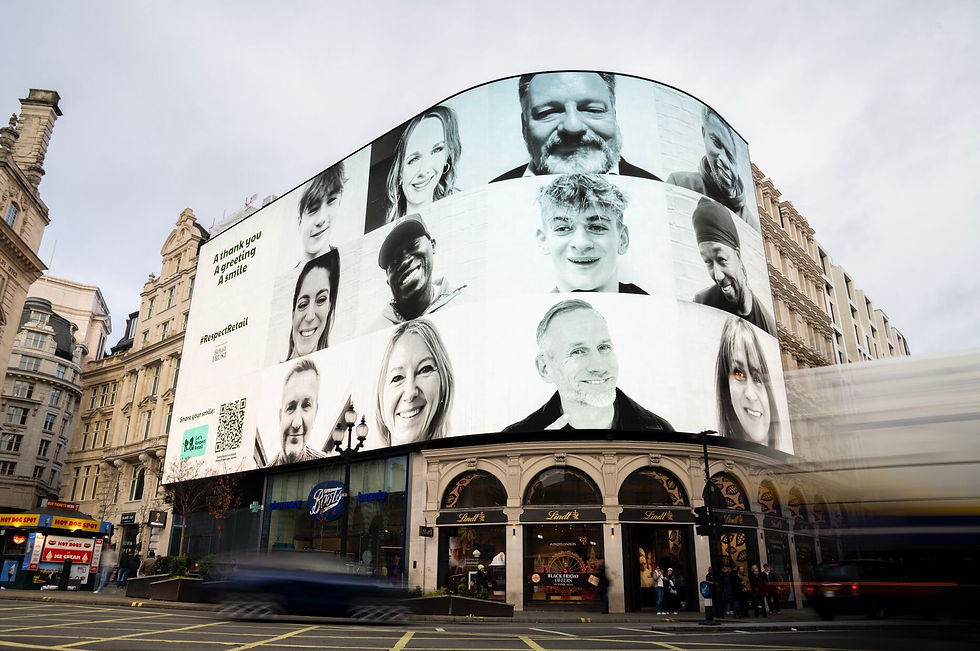
To engage such a wide audience, Let’s Respect Retail needs to build a movement for change and be culturally relevant. This extends beyond a trade issue. It has to directly challenge consumer behaviour, as well as working in a B2B and B2C space.
As Leila Fataar, Founder of Platform13 and culture led brand expert points out, “To be relevant, it’s no longer about what the brand says about itself; it’s about how the brand impacts people positively and what they say about it to others.”
Cultural movements need a simple action of shared ownership to tackle a very real enemy – in this instance, disrespect. Through human stories combined with recognisable symbols and language, we look create moments of momentum, communicated with warmth, humour and optimism.
In a world of relentless change and pervasive uncertainty, “the fundamental goal of creativity doesn’t change. Great communication speaks to the human spirit, creates culture and fights ignorance,” according to Sir John Hegarty.

That’s why the Retail Trust is asking people to show respect and kindness to workers in the run-up to Christmas, to reduce the abuse and the impact it is having on their mental health.
To create a national movement to bring humanity back to the high street - it starts with something small, but powerful – asking you to send in your smile of support. Turning the loudest shopping day of the year into a moment of respect. On Black Friday, screens across the UK, from Piccadilly Circus to Flannels and shopping centres nationwide - all will light up with thousands of smiles of respect.
This is just the start. We need your help. It falls on all of us to show a sign of respect. To look up from our phones. To smile. To fight for common decency and humanity. Let’s bring fun and joy back to shopping again. And show each other a little more respect.
Join the movement here.


Comments